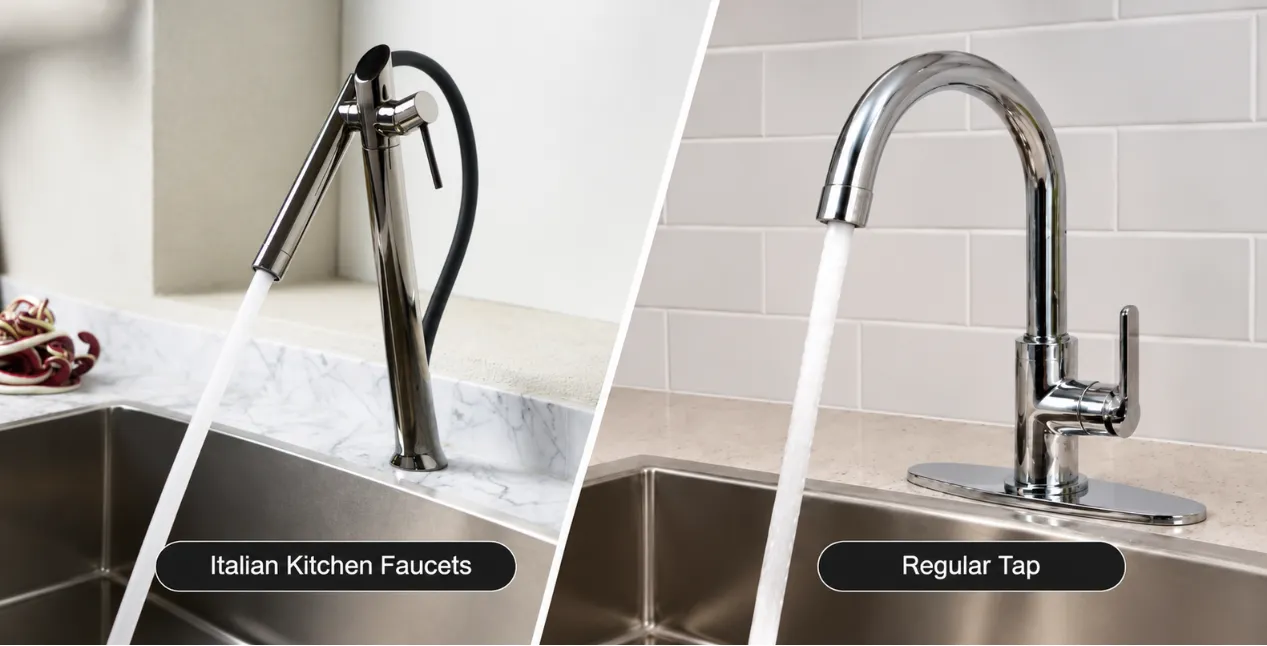
Italian Kitchen Faucets vs. Regular Tap

Italian Kitchen Faucets vs. Regular Taps: What’s the Difference?

The stone is chosen with great care. The cabinetry, lighting, and handles are all taken into account. And then each morning, your hand goes to the exact same small detail – the tap.

It is a part of your daily life that deserves more consideration than it normally gets. An Italian kitchen tap can add some well-designed elements of flexibility, whereas a common tap would provide a reliable water supply only.

This is how, at FIMA, we look at this decision in the context of the link between design and functionality. This is what you should consider when making a decision.

What Makes Italian Kitchen Faucets Different?

Both “faucet” and “tap” refer to the same fixture. The use of an Italian name does not necessarily guarantee superiority, just as a low cost does not guarantee bad quality.

In the comparison to be made, regular taps will refer to simple taps that deliver water without having any extra functions. Italian kitchen taps will refer to taps designed by Italian firms, with some having movable taps and also spray heads which can be extracted.

Even some regular taps have such features. It is the way a particular fixture integrates these aspects that counts.

A properly selected kitchen faucet should fit into your activities as much as it fits into your kitchen.

Italian Kitchen Faucets vs. Regular Taps at a Glance

Feature Design-led Italian models Basic regular taps
Design approach Greater attention to proportions and coordinated finishes. Often prioritise straightforward utility.
Spout movement Swivel or extractable options on selected models. Fixed or swivel options, depending on design.
Water delivery Multiple spray modes on some models. Usually a single stream.
Purchase price May include a premium for design and added functions. Often a lower initial investment.
Installation Must match plumbing, mounting, and operating requirements. Also requires compatibility checks.
Maintenance Finishing care and replacement components need consideration. Simpler designs may involve fewer components.

You should compare the specifications first before making any decisions. Price and looks are not everything.

Design That Belongs in the Kitchen

Proportions Make the Difference

A tap is placed against the background of your countertop and splashback. The proportions and contour of the tap can match that background or not fit in.

Italian taps for the kitchen may be of interest to people wanting such an element to play a part in the interior design. A sleek design will look good next to minimalistic cabinets, whereas a more elaborate design will be a focal point above your island sink.

Yet, the size will play a role. A large kitchen sink tap may be too dominant in a small washroom space, especially under small shelves.

Before buying such a tap, see how it looks with your sink size and other surfaces around it. A great design should not deprive you of working space.

Choose Finishes With Purpose:


Our range of  FIMA Flexi comprises various body finishes and hoses that match the selected body finishes.

On the collection page, there is information about the availability of chrome, brushed nickel, and matt black finishes, among others, with matching hoses.

This enables the faucet to be included in a thoughtful choice of materials.

When you need to compare Italian kitchen faucets, ask for samples of their finishes.

Try to test them in comparison with your handles and other items in your kitchen in real conditions and not just in photographs.

How Do They Change Everyday Use?

The distinction is easier to see when you wash a large pan or rinse the corners of your sink.

In the case of a static spout, you shift the item under the flow. With an extractable one, you can bring water towards the object.
Some selected  kitchen faucets have such extra mobility, which may help in more complex cleaning jobs. The swivel spout is also a nice addition that directs water over a bigger washing surface.

For instance, FIMA offers such characteristics as a swivel spout and extractable brass handshower with two jets in their Skinny F7026. Remember, it is a model-specific characteristic, so you should take into account your exact choice. Taps and accessories are produced in Italy

Here are some things to keep in mind when testing a kitchen faucet:

1. Does the spout extend to places you need to clean?
2. Is the spray head easy to hold in your hands?
3. Does the hose reach and retract easily?
4. Does the lever work freely near the splashback?

A kitchen faucet from Italy should be appreciated for useful movements, not for unnecessary ones.

Construction Matters More Than Country of Origin

While surface finish draws first attention, it is equally important to consider the internal parts.

Enquire about the construction materials and the valve system. See if the producer gives detailed technical information about the product and if there are local sources for spare parts.

A good-quality standard faucet can be a reliable option. Similarly, even expensive fittings have to be installed and maintained properly.

When assessing  Italian kitchen faucets, it is essential not to assume that all of them are constructed using the same materials and cartridges. Technical data must confirm the claim of construction.

If you want to install a kitchen faucet with a removable head, make sure that you have enough space under the sink for movement.

Our published information about products at FIMA can help in making comparisons. Clarify installation details with the producer beforehand.

Do Premium Taps Automatically Save Water?

NO. Water consumption varies by flow rate and by how you operate the fixture.

An aerator could be used to control the form of water flow, while a flow-limiting device would control the amount of water flow. Looks or origins do not guarantee any particular water saving.

According to the US Environmental Protection Agency, five minutes of water flow during dishwashing could use up to 10 US gallons (approximately 38 litres).

This is an example of the water-saving benefits of turning off water while performing some tasks; however, it neither assesses the performance of Italian kitchen faucets nor guarantees any specific water saving from a particular product.

Also, the US Environmental Protection Agency claims that household leaks in the USA waste nearly one trillion gallons per year in Fix a Leak Week campaign summaries.

These statistics relate to water consumption in households, not to any Indian kitchen fixtures in particular. The main message of all of this is that any leaks should be repaired and water flow rates should be compared.

A kitchen sink faucet should deliver enough water without any wasteful flow.

Installation: The Detail That Protects Your Investment

Thoughtfully designed Italian kitchen faucets still require proper installation conditions.

Before ordering, please be sure:

1. Mounting: Number of holes, diameter of holes, thickness of the work surface.
2. Pressure: Compliance of operating conditions of the product with those of water.
3. Clearances: Space for moving the lever and rotating the spout.
4. Connection: The requirement of the hot and cold water connections.
5. Under-sink space: No obstacles to pulling out hoses (bins and pipes).

If you have only a cold-water supply in your kitchen, then before buying a mixing faucet, make sure it is compatible. A kitchen sink faucet should be consistent with your plumbing.

Please ask your plumber to verify the chosen technical drawing. This minor move can save your nice purchase from an inappropriate one.

Care That Keeps the Finish Looking Its Best

Follow the instructions on cleaning your selected finish. Use a soft cloth and a recommended cleaning process to prevent any extra damage. Do not assume that a cleaner recommended for the sink is good enough for the tap too.

If water causes any deposits, contact the supplier on how to clean it safely. If an abrasive pad is used, ensure that it has been approved by the manufacturer. It is better to maintain regular care and avoid accumulation of deposits before trying to clean them off aggressively.

Keep the receipt, model number, and the warranty paperwork together. Ask who will service the product and how replacement parts can be provided before making any order.

Wrapping Up

The attractiveness of Italian kitchen faucets stems from the impact of good design on mundane activities. The value of the product is felt when the proportions fit your room and the movements fit your habits.

Choosing the right kitchen sink faucet depends on its design, functionality, and maintenance needs. At  FIMA Carlo Frattini India we offer thoughtfully designed faucets that combine style, quality, and everyday convenience for your kitchen.

FAQs

Is an Italian kitchen faucet worth the investment?

An Italian kitchen faucet might be worth the extra money if its design and functionality work for you. Do not decide based only on looks and the nationality of the brand; compare the design, usability, and maintenance of a specific product.

Can I change a regular faucet into a kitchen sink faucet?

Yes, but only if it fits your sink in terms of the number of holes and space needed for plumbing. The installer can tell if it fits the technical specifications.

How does the pull-out faucet differ from the swivel tap?

The pull-out faucet has a removable head that allows for directing water from different angles within the sink. The swivel tap has a swivel spout but does not have to be pulled out. Sometimes the two may be combined.

Do kitchen faucets from Italy save water?

It cannot be assumed right off the bat. The amount of water used depends on the flow rate of the faucet and how the user operates it.